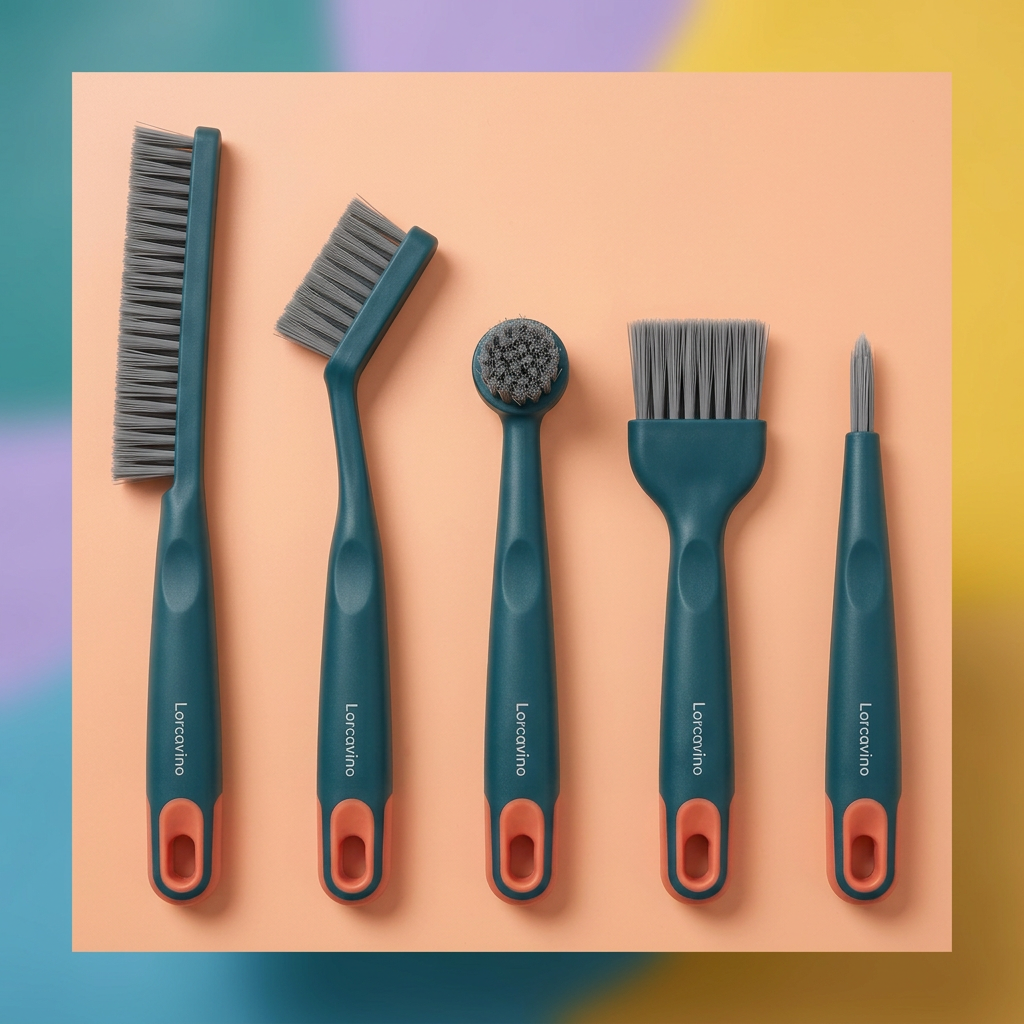
Lorcavino 5-Piece Precision Cleaning Brush Set with Narrow, Angled, Round, Flat & Fine-Tip Heads for Thoughtful Household Detail Cleaning
Lorcavino 5-Piece Precision Cleaning Brush Set with Narrow, Angled, Round, Flat & Fine-Tip Heads for Thoughtful Household Detail Cleaning
Couldn't load pickup availability

Lorcavino 5-Piece Precision Cleaning Brush Set with Narrow, Angled, Round, Flat & Fine-Tip Heads for Thoughtful Household Detail Cleaning
🔦 Look Closer. The Small Edges Deserve Their Own Tools.
The broad surface is easy to notice. It is the edge beside it that takes a little more thought: the accessible groove of a storage tray, the corner of a washable household item or the narrow area a wide cleaning tool cannot comfortably follow.
The Lorcavino Precision Cleaning Brush Set approaches these jobs through shape. Five manual brushes offer a long narrow head, an angled rectangular head, a small round head, a broad flat head and a fine bristle tip. Instead of asking one brush to fit every contour, you choose a profile that suits the accessible area in front of you.
Deep teal handles, coral-colored end accents and gray bristles create a coordinated set with a distinctive look. The idea is practical: observe the detail, choose thoughtfully and work with control rather than force.
🔷 Choose by Shape Before You Choose by Size
A small area does not always call for the smallest brush. A long accessible groove may benefit from a narrow row of bristles, while an open corner might be easier to approach with a rounded head. A flat patch and a curved recess can ask for different contact angles even when they occupy similar amounts of space.
Begin with the surface itself. Check the manufacturer's care instructions, identify any coating or delicate finish and confirm that brushing is an approved method. Then compare the available brush shapes with the area you can reach comfortably.
Do not force a head into a gap merely because the handle fits nearby. The working bristles need room to move without the hard body scraping the surrounding material.
🖐️ Five Profiles, Five Ways to Approach a Detail
The Long Narrow Brush: Follow an Accessible Line
A slim, elongated bristle arrangement offers a linear profile. On a compatible surface, position it along an accessible groove or edge and use short controlled strokes. Work toward an open area where loosened debris can be collected rather than pushing it deeper into a recess.
A narrow profile does not make the brush suitable for electrical ports, sealed joints or fragile tracks. Keep the task within the care guidance of the item being cleaned.
The Angled Brush: Change the Approach
The bent neck changes the relationship between your hand and the rectangular brush head. It provides another way to position the bristles beside an accessible edge without treating wrist pressure as the solution to every awkward angle.
Check the clearance around the head before moving it. Keep the molded neck away from the surface, and stop if the position requires twisting, prying or forcing.
The Round Brush: Work a Defined Small Area
The circular head gives you a distinct contact shape for appropriately sized areas. Use light movements on a tested, compatible surface and inspect the result frequently. The round form is an alternative to the straight brush profiles, not a guarantee that every curved recess is suitable.
The Broad Flat Brush: Cover the More Open Section
A wider, flat arrangement of bristles offers another option when the accessible area is less confined. Let the bristles make controlled contact without pressing the handle or head edge against the material. Remove loose particles from the brush before moving to a more sensitive area.
The Fine-Tip Brush: Be Deliberate, Not Aggressive
The smallest tuft gives the set a more focused bristle profile. Use it only where a gentle brush is permitted and the area is safely accessible. It is not a scraper, a probe or a tool for dislodging internal electronic components.
Do not insert it into charging sockets, speaker openings or small mechanisms. A narrow tip can still cause damage when used for the wrong task.
🟧 Teal Handles. Coral Details. A Set That Belongs Together.
Each brush follows the same visual language: a deep teal molded handle, a coral-colored accent at the end and a small hanging opening. The head shapes vary, while the coordinated handles make the five pieces feel like one purposeful selection.
The Lorcavino wordmark keeps the branding understated. Gray bristles contrast with the colored handles so the working profile remains visually clear when you select a tool.
Exact measurements, handle composition, bristle fiber, stiffness ratings and chemical resistance are not specified in this description. Those details should be checked against the supplied product specifications before choosing a specialist application.
🧮 Make a Three-Part Decision for Every Surface
One: What is the material? A coating, polished finish, porous surface or soft material may require a different method from a robust uncoated item. Do not transfer assumptions from one surface to another.
Two: What kind of debris is present? Loose dust, sticky residue, mineral deposits and stains are not the same problem. A brush set does not make every residue suitable for scrubbing.
Three: Where will the loosened debris go? Plan a direction that moves it toward an accessible collection point. Avoid driving particles into a joint, opening or mechanism.
Only proceed when the material guidance, brush instructions and physical access support the task. Test a small hidden area first where appropriate, then inspect for scratching or other changes.
🚿 A Household Detail Routine, without the Guesswork
Begin with a removable, compatible household item that can be safely handled away from delicate surfaces. An empty tray or similar accessory can be easier to inspect when it is no longer crowded with belongings.
Clear loose objects, place the item on a suitable stable surface and choose the brush profile that matches the accessible detail. Use gentle strokes rather than crushing the bristles into a corner. Collect loosened debris using a material-appropriate method and review the area before continuing.
Where a cleaning liquid is needed, follow both the item's care guidance and the brush instructions for compatibility. No chemical is included or recommended by this description. Never mix cleaning products or assume a brush is resistant to every cleaner.
🧑🔧 A Brush Is Not a Pry Tool
The handles and brush necks provide a way to guide the bristles. They are not intended to lever open housings, remove sealant, separate fitted parts or scrape away coatings.
When a task starts to require significant force, reassess the method. If bristles splay severely, a head becomes trapped or the surface begins to change, stop. Switching to a smaller brush is not always enough; sometimes the right choice is a different approved cleaning process.
Keep the set away from exposed electrical components and never work on powered equipment. For electronics, follow the device manufacturer's instructions and use only expressly approved tools and methods.
🧽 Divide the Jobs, Not Just the Brush Shapes
Matching the head to the task is only part of a thoughtful routine. Keep brushes used in different household areas separate, particularly when one has contacted grime or a cleaning chemical.
Assign each tool a role and remember that the matching handle colors do not identify hygiene zones for you. A simple storage plan can help prevent a tool used in one area from being casually moved to another.
Do not use household cleaning brushes for teeth, skin, grooming, food preparation or contact with food unless the product is specifically approved for that purpose. No such approval is claimed here.
🪟 A Small Finish You Notice Later
You empty a storage tray, set its contents aside and look at the corners that normally remain hidden. A wide cloth has handled the open surface, but an accessible edge needs a more focused approach.
You choose a suitable brush, check the material guidance and try a discreet area. A few light strokes, a pause to inspect and a controlled movement toward the open side. The task becomes a sequence of small decisions rather than one hard scrub.
When the tray returns to its place, the difference is not a dramatic transformation. It is the satisfaction of having given the detail an appropriate method, then put the tools away ready for the next approved task.
🧷 Store the Shapes Where You Can See Them
The handle-end openings offer a defined feature for suitable hanging storage if the product instructions permit it. Choose a secure arrangement that supports the brushes without bending the bristles or placing them against dirty surfaces.
If you store the set in a drawer, leave room around the heads so the bristles are not crushed beneath other tools. Keep the brushes dry according to their care guidance, and avoid sealing away residual moisture.
A storage rack, hooks, carrying case and wall fittings are not described as included. The product concept is the five manual brushes themselves.
🧴 After the Detail Comes Tool Care
Follow the supplied care instructions for removing debris and cleaning each brush. Do not assume that boiling, machine washing, bleach, solvents or high heat are suitable for the handles or bristles.
Inspect the working ends after use. Trapped grit can affect the next surface you brush, and bent or damaged components should not be treated as harmless. Stop using a brush if it no longer holds its intended shape or shows damage that could affect control.
Allow any approved cleaned parts to dry fully before returning the set to storage. Keep the brushes and any cleaning products out of children's and pets' reach.
🧭 Your First-Use Sequence
- Identify the surface. Read its care guidance and check whether brushing is permitted.
- Inspect the set. Choose a clean, undamaged head with an appropriate shape.
- Plan the movement. Give the bristles room and decide how debris will be collected.
- Test discreetly. Use a small hidden area where testing is appropriate.
- Work lightly. Keep the hard handle and head body from scraping the material.
- Review often. Stop at any sign of scratching, catching or unexpected change.
- Reset the tools. Clean and dry as instructed, then return each brush to its assigned place.
💬 Practical Questions, Clear Expectations
How many brushes are in this design?
The proposed set contains five manual brushes: long narrow, angled rectangular, round, broad flat and fine-tip bristle profiles.
Will the brushes clean every gap?
No universal reach or surface compatibility is promised. Check the actual opening, brush clearance and material guidance before proceeding.
Are the bristles scratch-proof?
No scratch-free guarantee is claimed. Test appropriately, use light pressure and avoid sensitive surfaces without express approval.
Can they remove mold, disinfect or sterilize?
No mold-treatment, disinfecting or sterilizing performance is claimed. This is a manual brush set, not a chemical or specialist treatment system.
Is cleaning liquid supplied?
No cleaning liquid, spray bottle or chemical product is part of the proposed five-brush set.
Are the household props included?
No. Trays, cloths, fixtures, furniture and decorative items in the images illustrate possible settings and are not included.
🍃 Give the Detail a Shape That Makes Sense.
A useful cleaning tool begins with a suitable task. Lorcavino brings five distinct brush profiles together so you can choose deliberately rather than forcing one broad tool into every small space.
Look closely, match the shape and work gently. Then collect the debris, care for the brushes and enjoy the quiet satisfaction of a detail thoughtfully finished.