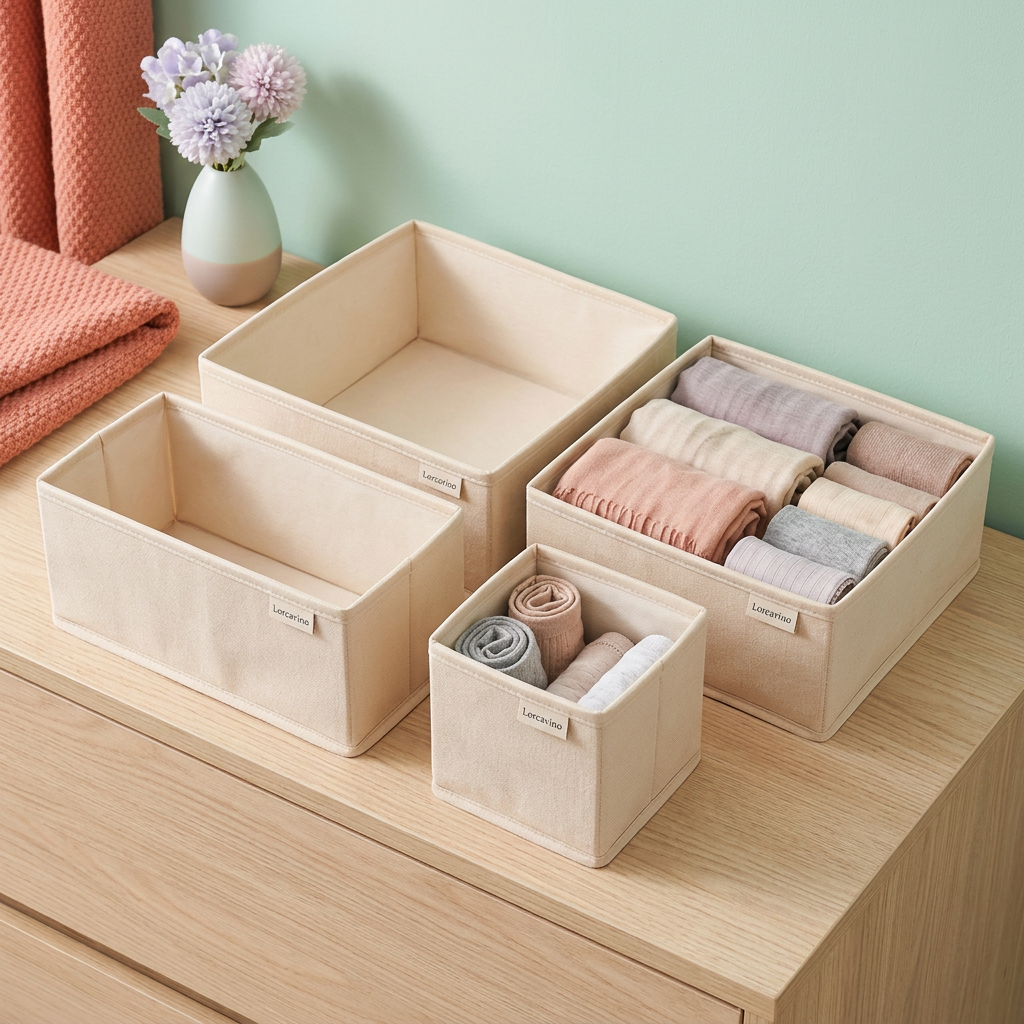
Lorcavino Foldable Fabric Drawer Organizer Set with Open-Top Storage Bins for Socks, Underwear, Scarves & Everyday Wardrobe Essentials in Beige
Lorcavino Foldable Fabric Drawer Organizer Set with Open-Top Storage Bins for Socks, Underwear, Scarves & Everyday Wardrobe Essentials in Beige
Couldn't load pickup availability

Lorcavino Foldable Fabric Drawer Organizer Set with Open-Top Storage Bins for Socks, Underwear, Scarves & Everyday Wardrobe Essentials in Beige
🧦 The Drawer You Open Every Morning Deserves a Better Arrangement
There is a difference between a drawer that closes and a drawer that makes sense. One holds everything behind a front panel. The other lets you see the socks you meant to wear, the neatly folded essentials and the little accessories that used to disappear beneath them.
The Lorcavino Foldable Fabric Drawer Organizer Set is about creating that second kind of space. Beige, open-top bins turn a broad drawer into distinct areas for the things you reach for regularly. Upright sides give each category a boundary, while the open layout keeps the contents visible when you look down.
No elaborate labeling system is required to begin. Start with what you own, separate it into useful groups and give each group a place. The result is not an extra drawer or a promise of perfect tidiness. It is a clearer arrangement inside the space already there.
🟨 Your First Decision Is Not Where the Boxes Go
Before placing a single organizer, empty the drawer and look at its contents. What belongs together? What do you use most often? Which pieces need a gentler fold, and which can sit comfortably in a loose roll?
Grouping first helps you avoid designing an arrangement around the wrong things. A large collection of socks needs a different plan from a drawer devoted to lingerie, scarves or small everyday accessories. Let the contents suggest the zones, then use the bins to give those zones a visible outline.
The neutral beige palette keeps the organizers visually quiet. Cream, gray, lilac and brighter garments can sit beside one another without the boxes competing for attention. The fabric finish adds a softer look than a row of exposed hard-sided trays.
🧱 Build Boundaries Without Turning the Drawer into a Fixed Grid
These organizers use open interiors rather than a narrow individual cell for every item. That distinction gives you room to choose how each category sits inside a bin. Arrange socks in short visible rows, keep folded underwear together or give small scarves their own section.
The separate bins can be positioned as independent pieces wherever the actual drawer dimensions allow. Try a longer section along the back, a smaller category near the front or a pair of bins side by side. The layout is yours to plan; the bins are not physically adjustable in size, and universal drawer compatibility is not promised.
Leave enough room for the drawer to move freely. The right arrangement should not bow the sides, interfere with runners or cause clothing to rub against the frame each time you close it.
📏 Plan the Fit Before the First Fold
- Measure the usable interior. Check the drawer's clear width and depth, not the outside dimensions of the furniture.
- Check height clearance. Account for the organizers and the clothing you intend to place inside them.
- Notice obstructions. Runners, sloping panels and projecting hardware can reduce the useful space.
- Test an empty arrangement. Position the bins without forcing them against the drawer walls.
- Check movement before loading. Open and close the drawer gently, confirming that nothing catches.
Exact organizer measurements are not specified in this description. Use the actual product dimensions when planning a particular layout rather than treating a styled photograph as a scale drawing.
🩶 Three Ways to Give a Category Its Own Place
Visible Rows for Socks
Pair socks in a way that suits their fabric, then use a gentle fold or loose roll. Place them so the colors and styles you need are visible from above rather than buried beneath several layers. Keep enough room between rows to take out one pair without pulling the others along.
Avoid stretching a sock tightly over its partner simply to create a smaller bundle. Follow the garment's care guidance and choose a fold that is kind to the elastic.
A Considered Section for Underwear
Fold suitable everyday pieces into a consistent shape and arrange them together. More structured garments need their own approach: molded cups, underwires and decorative details should not be crushed to fit a predetermined fold.
Use an appropriately sized bin and preserve the garment's natural shape where needed. If a piece requires more room than the available space allows, choose a different storage method rather than pressing it into place.
A Defined Area for Accessories
Small scarves, soft accessories and suitably sized coiled belts can have their own zone. Keep metal buckles or sharp decorative details from pressing directly against delicate clothing or the organizer lining.
A separate category is useful only when it remains easy to use. Do not fill the bin so tightly that taking out one accessory means unpacking the rest.
🛏️ The Morning Test: Can You Find It Without Rearranging Everything?
A finished drawer can look beautiful for a photograph. A useful drawer still makes sense on a normal morning. The practical test is simple: can you identify the piece you need, take it out and leave the rest reasonably in place?
Put frequently used categories where they are easiest for you to reach. If your everyday socks are always hidden at the back while occasional accessories occupy the front, swap the zones. If one bin is overflowing while another is mostly empty, reconsider the grouping before adding more storage.
Good organization is allowed to change. The separate-bin format gives you a way to revise the arrangement as your wardrobe or routine changes, provided the new positions fit comfortably in the drawer.
🧶 A Closer Look at the Quiet Details
- Open-top access: the contents remain visible from above without an individual lid to remove.
- Fabric-covered walls: a coordinated textile appearance brings a softer visual finish to the storage area.
- Bound upper edges: defined rims outline each category and give the bins a finished look.
- Separate box shapes: independent pieces let you plan categories around the actual available space.
- Foldable bodies: empty organizers can be folded using the supplied method when they are not needed.
- Understated beige color: a neutral backdrop works with a mix of garment colors and patterns.
Specific fiber composition, internal reinforcement materials and load ratings are not established here. The bins are presented for lightweight wardrobe organization, not as heavy-duty carrying boxes.
🧘 A Reset You Can See Every Time You Open the Drawer
Imagine putting away a fresh load of laundry. Instead of creating another mixed stack, you return each group to its place. Socks join the visible rows. Folded essentials go into their section. The scarf you wore yesterday returns to the accessory bin.
The next morning, you open the drawer and the arrangement is familiar. You do not need to remember which side of a loose pile holds the right pair. The categories are already there, outlined by the beige walls and organized in the way you chose.
It is a modest change, not a complete wardrobe makeover. But it touches a part of the day that happens again and again, making the drawer feel intentional rather than merely full.
🧺 The Laundry-to-Drawer Routine
First, sort before storing. Return only clean, fully dry garments to the drawer and separate them into the categories you already use.
Next, fold for visibility. Choose a consistent shape where appropriate so you can recognize pieces from above. Use gentle folds rather than forcing delicate garments into tight bundles.
Then, leave working space. A little room around the contents makes it easier to take one item out and put another back. A bin packed beyond comfortable access is a cue to review the selection.
Finally, make a small correction. Straighten a row, move an accessory back to its zone or adjust one category before the next load arrives. The system works best as a short habit, not a one-time display.
🗃️ When a Category Changes, the Empty Box Can Change Too
Seasonal clothing, a move or a wardrobe edit can leave you with an organizer you do not currently need. The foldable format gives that empty bin another option besides remaining upright on a shelf.
Remove all contents, follow the folding instructions supplied with the product and store the empty body in a clean, dry place. Do not force reinforced areas, tear seams or assume there is a particular zipper or removable panel unless the supplied design includes one.
No numerical space-saving percentage is claimed. The benefit is the ability to fold an unused body, with the final stored profile depending on the actual construction and folding method.
🧹 Keep the Storage Area Ready for Clean Clothes
Empty the organizers periodically and clear lint or loose debris from the drawer. Follow the care instructions supplied with the bins, using only approved cleaning methods. Machine washing, soaking, tumble drying and solvent cleaning are not assumed to be suitable.
Allow cleaned surfaces to dry fully before replacing clothing. Keep damp garments, spills and wet footwear out of the bins. Foldable fabric storage should not be treated as a moisture barrier or a substitute for an appropriately dry storage environment.
Lift or move the boxes carefully, supporting the base rather than pulling on the rim when contents are inside. Avoid overloading the walls, pressing heavy objects into the fabric or using the bins as handles for removing a packed drawer.
🧭 Choose the Layout That Matches Your Wardrobe
The Everyday Essentials Drawer
Keep socks and underwear in separate categories, placing the most frequently used pieces within easy reach. Arrange the remaining space around the items that genuinely belong in that drawer.
The Accessory Drawer
Group soft scarves, suitable belts and other small wardrobe accessories according to how you use them. Keep hard hardware from rubbing against delicate materials.
The Mixed Wardrobe Drawer
Give each category a defined bin instead of mixing everything into the same pile. If the drawer is shallow, check both the wall height and the height of the folded contents before closing it.
These are planning ideas, not promises that every pictured arrangement will fit every piece of furniture. A comfortable physical fit should always guide the final configuration.
❔ Practical Questions Before You Start
Does each bin have individual compartments inside?
The described design uses open-top boxes with open interiors. The separate bins create the categories; individual grid cells or removable interior dividers are not claimed.
Will the organizers fit any drawer?
No universal fit is promised. Check the drawer's usable dimensions and clearance against the actual organizer measurements before choosing your layout.
Can I wash the fabric boxes in a machine?
Machine-wash compatibility is not confirmed here. Follow the supplied product care instructions.
Can the bins be folded while full?
The folding feature is presented for empty storage. Remove the contents first and use the approved folding method.
Are the clothes, drawer and styling accessories included?
No. Garments, belts, furniture and decorative props shown in the photographs illustrate possible uses and are not included.
Do the bins prevent moths, moisture or dust?
Those protective effects are not claimed. The open-top design is intended for organization and does not form a sealed enclosure.
🌤️ Start with One Drawer. Make It Work for You.
You do not need to reorganize the entire room to make a useful change. Begin with the drawer you open most often. Remove what does not belong, group the things you keep and arrange the bins around the way you actually get dressed.
Lorcavino's foldable fabric organizers bring visible boundaries, open access and a neutral finish to that everyday space. Give your essentials a place, leave room to reach them and make the next morning a little less about searching.